# MARSHAL: Incentivizing Multi-Agent Reasoning via Self-Play with Strategic LLMs
### 🎉 Accepted by ICLR 2026
[](https://opensource.org/licenses/Apache-2.0)
[](https://www.python.org/downloads/release/python-390/)
[](https://arxiv.org/abs/2510.15414)
[**🌐 Project Page**](https://thu-nics.github.io/MARSHAL/) | [**📝 Paper**](https://arxiv.org/abs/2510.15414) | [**💻 Code**](https://github.com/thu-nics/MARSHAL)
---
## 🤗 Model Description
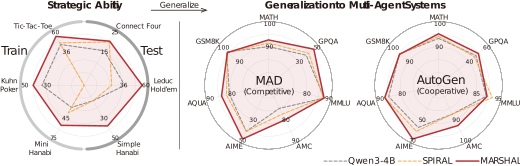
This is the **generalist model** of the **MARSHAL** framework, initialized from **Qwen3-4B**. It has been trained via self-play on a diverse set of strategic games—**Tic-Tac-Toe**, **Kuhn Poker**, and **Mini Hanabi**—encompassing both competitive and cooperative dynamics, as well as perfect and imperfect information settings.
## 📖 Overview
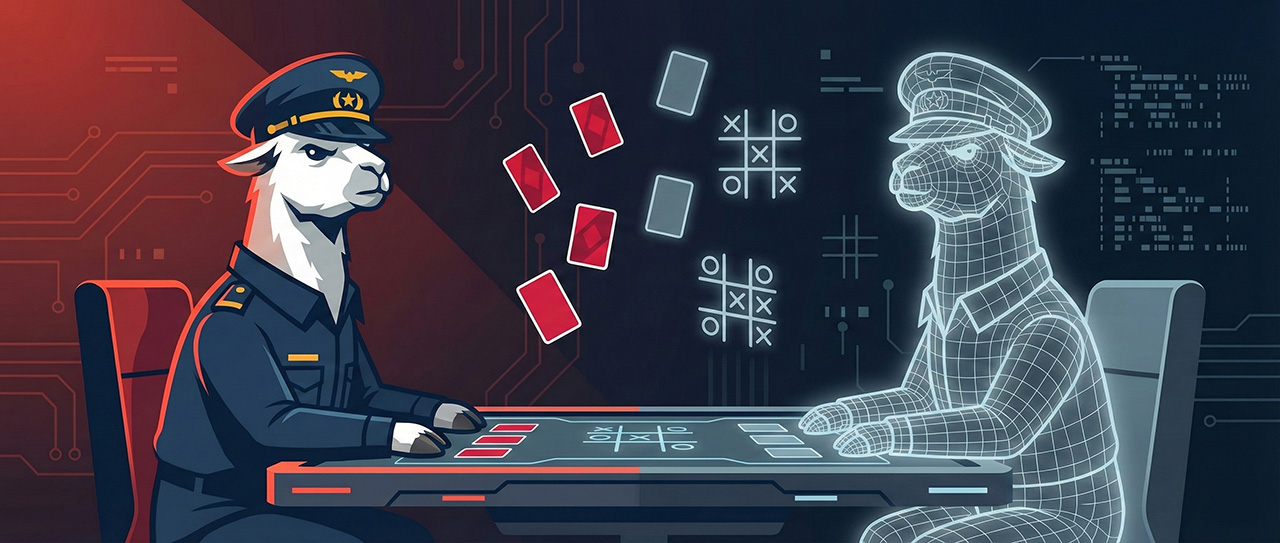
We introduce **MARSHAL**, an end-to-end reinforcement learning framework designed to incentivize **M**ulti-**A**gent **R**easoning through **S**elf-play wit**H** str**A**tegic **L**LMs in a diverse range of competitive and cooperative games.
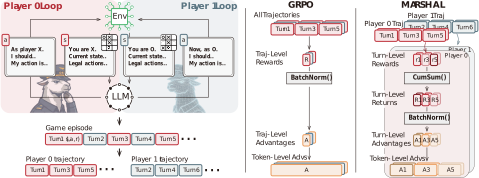
MARSHAL addresses the challenge of credit assignment in multi-agent multi-turn self-play through two core mechanisms:
1. **Turn-level Advantage Estimator:** Enables fine-grained credit assignment, allowing the model to accurately attribute long-term outcomes to individual actions and provide learning signals across multiple turns.
2. **Agent-specific Advantage Normalization:** Stabilizes the training
process by calibrating advantage estimates relative to the performance of each agent.
### 🔥 Key Results
By leveraging self-play across strategic games, MARSHAL (based on Qwen3-4B) demonstrates notable generalization capabilities:
- **Strategic Games:** Achieves up to **28.7%** performance improvement on held-out games.
- **Reasoning Benchmarks:** When integrated into leading multi-agent systems (MASs), MARSHAL yields consistent gains of up to
- **+10.0%** on AIME
- **+7.6%** on GPQA-Diamond
- **+3.5%** on average across all tested benchmarks.
### 🎮 Featured Games
- **Competitive, perfect-information:** Tic-Tac-Toe, Connect Four.
- **Competitive, imperfect-information:** Kuhn Poker, Leduc Hold'em.
- **Cooperative, imperfect-information:** Mini Hanabi, Simple Hanabi.
---
## 🚀 Method