
Accelerate documentation
使用 Accelerate 执行梯度累积
使用 Accelerate 执行梯度累积
梯度累积是一种技术,它允许你使用比机器内存通常能容纳的更大的批大小进行训练。其实现方式是在多个批次上累积梯度,并在执行了特定数量的批次后才更新优化器。
虽然从技术上讲,标准的梯度累积代码在分布式环境中也能正常运行,但这并不是最高效的方法,您可能会遇到明显的性能下降!
在本教程中,您将了解如何快速配置梯度累积,并使用 Accelerate 提供的工具来执行它,总共只需新增一行代码!
本示例将使用一个非常简单的 PyTorch 训练循环,该循环每两个批次执行一次梯度累积:
device = "cuda"
model.to(device)

gradient_accumulation_steps = 2

for index, batch in enumerate(training_dataloader):
    inputs, targets = batch
    inputs = inputs.to(device)
    targets = targets.to(device)
    outputs = model(inputs)
    loss = loss_function(outputs, targets)
    loss = loss / gradient_accumulation_steps
    loss.backward()
    if (index + 1) % gradient_accumulation_steps == 0:
        optimizer.step()
        scheduler.step()
        optimizer.zero_grad()
将其转换为 Accelerate
首先,前面展示的代码将被转换为使用 Accelerate,而不使用特殊的梯度累积辅助函数:
+ from accelerate import Accelerator
+ accelerator = Accelerator()

+ model, optimizer, training_dataloader, scheduler = accelerator.prepare(
+     model, optimizer, training_dataloader, scheduler
+ )

  for index, batch in enumerate(training_dataloader):
      inputs, targets = batch
-     inputs = inputs.to(device)
-     targets = targets.to(device)
      outputs = model(inputs)
      loss = loss_function(outputs, targets)
      loss = loss / gradient_accumulation_steps
+     accelerator.backward(loss)
      if (index+1) % gradient_accumulation_steps == 0:
          optimizer.step()
          scheduler.step()
optimizer.zero_grad()就目前的代码而言,由于梯度同步这一过程的存在,它无法高效地执行梯度累积。有关该过程的更多信息,请参阅概念教程!
让 Accelerate 处理梯度累积
现在剩下的就是让 Accelerate 为我们处理梯度累积。为此,你应该向 Accelerator 传入一个 gradient_accumulation_steps 参数,以指定在每次调用 step() 之前要执行的步数,以及如何在调用 backward() 时自动调整损失:
  from accelerate import Accelerator
- accelerator = Accelerator()
+ accelerator = Accelerator(gradient_accumulation_steps=2)
或者,您可以将 gradient_accumulation_plugin 参数传递给 Accelerator 对象的 __init__,从而进一步自定义梯度累积行为。
有关此功能的更多信息,请参阅 GradientAccumulationPlugin 文档。
从这里开始,你可以在训练循环内部使用 accumulate() 上下文管理器,自动为你执行梯度累积! 你只需将其包裹在代码的训练部分周围即可:
- for index, batch in enumerate(training_dataloader):
+ for batch in training_dataloader:
+     with accelerator.accumulate(model):
          inputs, targets = batch
          outputs = model(inputs)
您可以移除所有针对步数和损失调整的特殊检查:
- loss = loss / gradient_accumulation_steps
  accelerator.backward(loss)
- if (index+1) % gradient_accumulation_steps == 0:
  optimizer.step()
  scheduler.step()
optimizer.zero_grad()如你所见,Accelerator 能够跟踪你当前所处的批次编号,并自动判断是否需要对准备好的优化器执行步进,以及如何调整损失值。
通常在使用梯度累积时,你需要调整步数,以反映训练所用总批次的变化。Accelerate 默认会自动为你完成这一操作。在底层,我们会实例化一个配置为执行此操作的
GradientAccumulationPlugin。
state.GradientState 会与当前正在迭代的活跃数据加载器保持同步。因此,它默认假设当到达数据加载器末尾时,所有状态都会同步并执行一次更新。若要禁用此行为,请在
GradientAccumulationPlugin中将sync_with_dataloader设置为False:from accelerate import Accelerator from accelerate.utils import GradientAccumulationPlugin plugin = GradientAccumulationPlugin(sync_with_dataloader=False) accelerator = Accelerator(..., gradient_accumulation_plugin=plugin)
完成的代码
以下是使用 Accelerate 执行梯度累积的完整实现
from accelerate import Accelerator
accelerator = Accelerator(gradient_accumulation_steps=2)
model, optimizer, training_dataloader, scheduler = accelerator.prepare(
    model, optimizer, training_dataloader, scheduler
)
for batch in training_dataloader:
    with accelerator.accumulate(model):
        inputs, targets = batch
        outputs = model(inputs)
        loss = loss_function(outputs, targets)
        accelerator.backward(loss)
        optimizer.step()
        scheduler.step()
        optimizer.zero_grad()
重要的是,在上下文管理器
with accelerator.accumulate(model)内部,只能执行一次前向/反向传播。
要了解此功能背后的原理,请阅读梯度同步概念指南
自包含示例
下面是一个自包含的示例,您可以运行它以查看 Accelerate 中梯度累积的实际效果:
import torch
import copy
from accelerate import Accelerator
from accelerate.utils import set_seed
from torch.utils.data import TensorDataset, DataLoader

# seed
set_seed(0)

# define toy inputs and labels
x = torch.tensor([1., 2., 3., 4., 5., 6., 7., 8.])
y = torch.tensor([2., 4., 6., 8., 10., 12., 14., 16.])
gradient_accumulation_steps = 4
per_device_batch_size = len(x) // gradient_accumulation_steps

# define dataset and dataloader
dataset = TensorDataset(x, y)
dataloader = DataLoader(dataset, batch_size=per_device_batch_size)

# define model, optimizer and loss function
class SimpleLinearModel(torch.nn.Module):
    def __init__(self):
        super(SimpleLinearModel, self).__init__()
        self.weight = torch.nn.Parameter(torch.zeros((1, 1)))

    def forward(self, inputs):
        return inputs @ self.weight

model = SimpleLinearModel()
model_clone = copy.deepcopy(model)
criterion = torch.nn.MSELoss()
model_optimizer = torch.optim.SGD(model.parameters(), lr=0.02)
accelerator = Accelerator(gradient_accumulation_steps=gradient_accumulation_steps)
model, model_optimizer, dataloader = accelerator.prepare(model, model_optimizer, dataloader)
model_clone_optimizer = torch.optim.SGD(model_clone.parameters(), lr=0.02)
print(f"initial model weight is {model.weight.mean().item():.5f}")
print(f"initial model weight is {model_clone.weight.mean().item():.5f}")
for i, (inputs, labels) in enumerate(dataloader):
    with accelerator.accumulate(model):
        inputs = inputs.view(-1, 1)
        print(i, inputs.flatten())
        labels = labels.view(-1, 1)
        outputs = model(inputs)
        loss = criterion(outputs, labels)
        accelerator.backward(loss)
        model_optimizer.step()
        model_optimizer.zero_grad()
loss = criterion(x.view(-1, 1) @ model_clone.weight, y.view(-1, 1))
model_clone_optimizer.zero_grad()
loss.backward()
model_clone_optimizer.step()
print(f"w/ accumulation, the final model weight is {model.weight.mean().item():.5f}")
print(f"w/o accumulation, the final model weight is {model_clone.weight.mean().item():.5f}")initial model weight is 0.00000
initial model weight is 0.00000
0 tensor([1., 2.])
1 tensor([3., 4.])
2 tensor([5., 6.])
3 tensor([7., 8.])
w/ accumulation, the final model weight is 2.04000
w/o accumulation, the final model weight is 2.04000不同大小训练样本上的梯度累积
正如这篇博客文章所指出的,它揭示了一个在对大小不一的训练样本执行梯度累积时常见的错误:
[…] 对于因果语言模型训练等基于 token 的任务,在进行梯度累积时,正确的损失应通过梯度累积步骤中所有批次的总损失除以这些批次中所有非填充 token 的总数来计算。这与各批次损失值的平均值并不相同。
换言之,必须对基于 token 级别运行的损失函数进行一些调整。
统计实际对损失产生贡献的目标数量。对于内部会移位标签的 Transformers 因果语言模型,请传入未移位的标签,并统计 (labels[..., 1:] != -100).sum():第一个标签没有对应的先前预测。请勿在数据整理器中再次移位这些标签。自回归累积示例 采用了此约定;其他损失函数可能使用不同的目标对齐方式。
骨架代码
from accelerate import Accelerator
import math
import contextlib

gradient_accumulation_steps = 2
accelerator = Accelerator(gradient_accumulation_steps=gradient_accumulation_steps)
model, optimizer, training_dataloader, scheduler = accelerator.prepare(
    model, optimizer, training_dataloader, scheduler
)

training_iterator = iter(training_dataloader)
num_samples_in_epoch = len(training_dataloader)
remainder = num_samples_in_epoch % gradient_accumulation_steps
remainder = remainder if remainder != 0 else gradient_accumulation_steps
total_updates = math.ceil(num_samples_in_epoch / gradient_accumulation_steps)


total_batched_samples = 0
for update_step in range(total_updates):
        # In order to correctly the total number of non-padded tokens on which we'll compute the cross-entropy loss
        # we need to pre-load the full local batch - i.e the next per_device_batch_size * accumulation_steps samples
        batch_samples = []
        num_batches_in_step = gradient_accumulation_steps if update_step != (total_updates - 1) else remainder
        for _ in range(num_batches_in_step):
            batch_samples += [next(training_iterator)]

        # get local num items in batch
        num_items_in_batch = sum([(batch["labels"].ne(-100)).sum() for batch in batch_samples])
        # to compute it correctly in a multi-device DDP training, we need to gather the total number of items in the full batch.
        num_items_in_batch = accelerator.gather(num_items_in_batch).sum().item()

        for i, batch in enumerate(batch_samples):
            # if we perform gradient accumulation in a multi-devices set-up, we want to avoid unnecessary communications when accumulating
            # cf: https://muellerzr.github.io/blog/gradient_accumulation.html
            if (i < len(batch_samples) - 1 and accelerator.num_processes > 1):
                ctx = model.no_sync
            else:
                ctx = contextlib.nullcontext

            total_batched_samples += 1

            with ctx():
                inputs, targets = batch
                outputs = model(inputs)
                loss = loss_function(outputs, targets) # the loss function should sum over samples rather than averaging

                # We multiply by num_processes because the DDP calculates the average gradient across all devices whereas dividing by num_items_in_batch already takes into account all devices
                # Same reason for gradient_accumulation_steps, but this times it's Accelerate that calculate the average gradient across the accumulated steps
                loss = (loss * gradient_accumulation_steps * accelerator.num_processes) / num_items_in_batch

                accelerator.backward(loss)

        # Sync gradients and perform optimization steps once every gradient_accumulation_steps
        optimizer.step()
        scheduler.step()
        optimizer.zero_grad()
自包含的因果语言模型示例
import torch
import copy
from accelerate import Accelerator
from accelerate.utils import set_seed
from accelerate.logging import  get_logger
from torch.utils.data import Dataset, DataLoader
import math
import contexlib

# seed
set_seed(0)
logger = get_logger(__name__)

class MyDataset(Dataset):
    def __init__(self, num_samples):
        super().__init__()
        self.len = num_samples

    def __getitem__(self, index):
        input_ids = torch.arange(1, index+2, dtype=torch.float32)
        labels = torch.remainder(input_ids, 2)
        return {"input_ids": input_ids, "labels": labels}

    def __len__(self):
        return self.len

def collate_fn(features):
    input_ids = torch.nn.utils.rnn.pad_sequence([f["input_ids"] for f in features], batch_first=True, padding_value=-100)
    labels = torch.nn.utils.rnn.pad_sequence([f["labels"] for f in features], batch_first=True, padding_value=-100)
    return {"input_ids": input_ids[..., None], "labels": labels[..., None]}

# define toy inputs and labels
gradient_accumulation_steps = 2
per_device_batch_size = 4

# define accelerator
accelerator = Accelerator(gradient_accumulation_steps=gradient_accumulation_steps)

# define dataset and dataloader
# for this toy example, we'll compute gradient descent over one single global batch
dataset = MyDataset(per_device_batch_size*gradient_accumulation_steps*accelerator.num_processes)
dataloader = DataLoader(dataset, batch_size=per_device_batch_size, collate_fn=collate_fn)

# define model, model_optimizer and loss function
model = torch.nn.Linear(1, 2, bias=False)
model_clone = copy.deepcopy(model)
criterion = torch.nn.CrossEntropyLoss(reduction="sum") # must sum over samples rather than averaging
model_optimizer = torch.optim.SGD(model.parameters(), lr=0.08)


logger.warning(f"initial model weight is {model.weight.detach().cpu().squeeze()}")
logger.warning(f"initial model clone weight is {model_clone.weight.detach().cpu().squeeze()}")

# prepare artifacts - accelerator handles device placement and dataloader splitting
model, model_optimizer = accelerator.prepare(model, model_optimizer)
dataloader = accelerator.prepare_data_loader(dataloader, device_placement=True)
training_iterator = iter(dataloader)

num_samples_in_epoch = len(dataloader)
remainder = num_samples_in_epoch % gradient_accumulation_steps
remainder = remainder if remainder != 0 else gradient_accumulation_steps
total_gradient_updates = math.ceil(num_samples_in_epoch / gradient_accumulation_steps)

total_batched_samples = 0
for update_step in range(total_gradient_updates):
        # In order to correctly the total number of non-padded tokens on which we'll compute the cross-entropy loss
        # we need to pre-load the full local batch - i.e the next per_device_batch_size * accumulation_steps samples
        batch_samples = []
        num_batches_in_step = gradient_accumulation_steps if update_step != (total_gradient_updates - 1) else remainder
        for _ in range(num_batches_in_step):
            batch_samples += [next(training_iterator)]

        # get local num items in batch
        local_num_items_in_batch = sum([(batch["labels"].ne(-100)).sum() for batch in batch_samples])
        logger.warning(f"Step {update_step} - Device {accelerator.process_index} - num items in the local batch {local_num_items_in_batch}", main_process_only=False)

        # to compute it correctly in a multi-device DDP training, we need to gather the total number of items in the full batch.
        num_items_in_batch = accelerator.gather(local_num_items_in_batch).sum().item()
        logger.warning(f"Total num items {num_items_in_batch}")

        for i, batch in enumerate(batch_samples):
            inputs, labels = batch["input_ids"], batch["labels"]
            total_batched_samples += 1
            # if we perform gradient accumulation in a multi-devices set-up, we want to avoid unnecessary communications when accumulating
            # cf: https://muellerzr.github.io/blog/gradient_accumulation.html
            if (i < len(batch_samples) - 1 and accelerator.num_processes > 1):
                ctx = model.no_sync
            else:
                ctx = contextlib.nullcontext
            with ctx():

                outputs = model(inputs)
                loss = criterion(outputs.view(-1, 2), labels.view(-1).to(torch.int64))

                # We multiply by num_processes because the DDP calculates the average gradient across all devices whereas dividing by num_items_in_batch already takes into account all devices
                # Same reason for gradient_accumulation_steps, but this times it's Accelerate that calculate the average gradient across the accumulated steps
                loss = (loss * gradient_accumulation_steps * accelerator.num_processes) / num_items_in_batch
                accelerator.backward(loss)
        model_optimizer.step()
        model_optimizer.zero_grad()


logger.warning(f"Device {accelerator.process_index} - w/ accumulation, the final model weight is {accelerator.unwrap_model(model).weight.detach().cpu().squeeze()}", main_process_only=False)

# We know do the same operation but on a single device and without gradient accumulation

if accelerator.is_main_process:
    # prepare one single entire batch
    dataloader = DataLoader(dataset, batch_size=len(dataset), collate_fn=collate_fn)
    full_batch_without_accum = next(iter(dataloader))
    total_inputs, total_labels = full_batch_without_accum["input_ids"], full_batch_without_accum["labels"]
    model_clone_optimizer = torch.optim.SGD(model_clone.parameters(), lr=0.08)

    # train the cloned model
    loss = torch.nn.CrossEntropyLoss(reduction="mean")(model_clone(total_inputs).view(-1, 2), total_labels.view(-1).to(torch.int64))
    model_clone_optimizer.zero_grad()
    loss.backward()
    model_clone_optimizer.step()

    # We should have the same final weights.
    logger.warning(f"w/o accumulation, the final model weight is {model_clone.weight.detach().cpu().squeeze()}")
在单个设备上的结果 - 梯度累积步数设置为 1,batch_size 设置为 8:
initial model weight is tensor([-0.0075,  0.5364])
initial model clone weight is tensor([-0.0075,  0.5364])
Step 0 - Device 0 - num items in the local batch 36
Total num items 36
Device 0 - w/ accumulation, the final model weight is tensor([0.0953, 0.4337])
w/o accumulation, the final model weight is tensor([0.0953, 0.4337])
在双设备配置上的结果 - 梯度累积步数设置为 2,batch_size 设置为 4。
initial model weight is tensor([-0.0075,  0.5364])
initial model clone weight is tensor([-0.0075,  0.5364])
Step 0 - Device 0 - num items in the local batch 52
Step 0 - Device 1 - num items in the local batch 84
Total num items 136
Device 1 - w/ accumulation, the final model weight is tensor([0.2117, 0.3172])
Device 0 - w/ accumulation, the final model weight is tensor([0.2117, 0.3172])
w/o accumulation, the final model weight is tensor([0.2117, 0.3172])
进一步探索:
完整的实际训练运行示例脚本位于 accelerate/examples/by_feature/gradient_accumulation_for_autoregressive_models.py 路径下的 examples 文件夹中。
在多个训练配置下运行,保持全局批大小恒定为 32,得到以下图表:
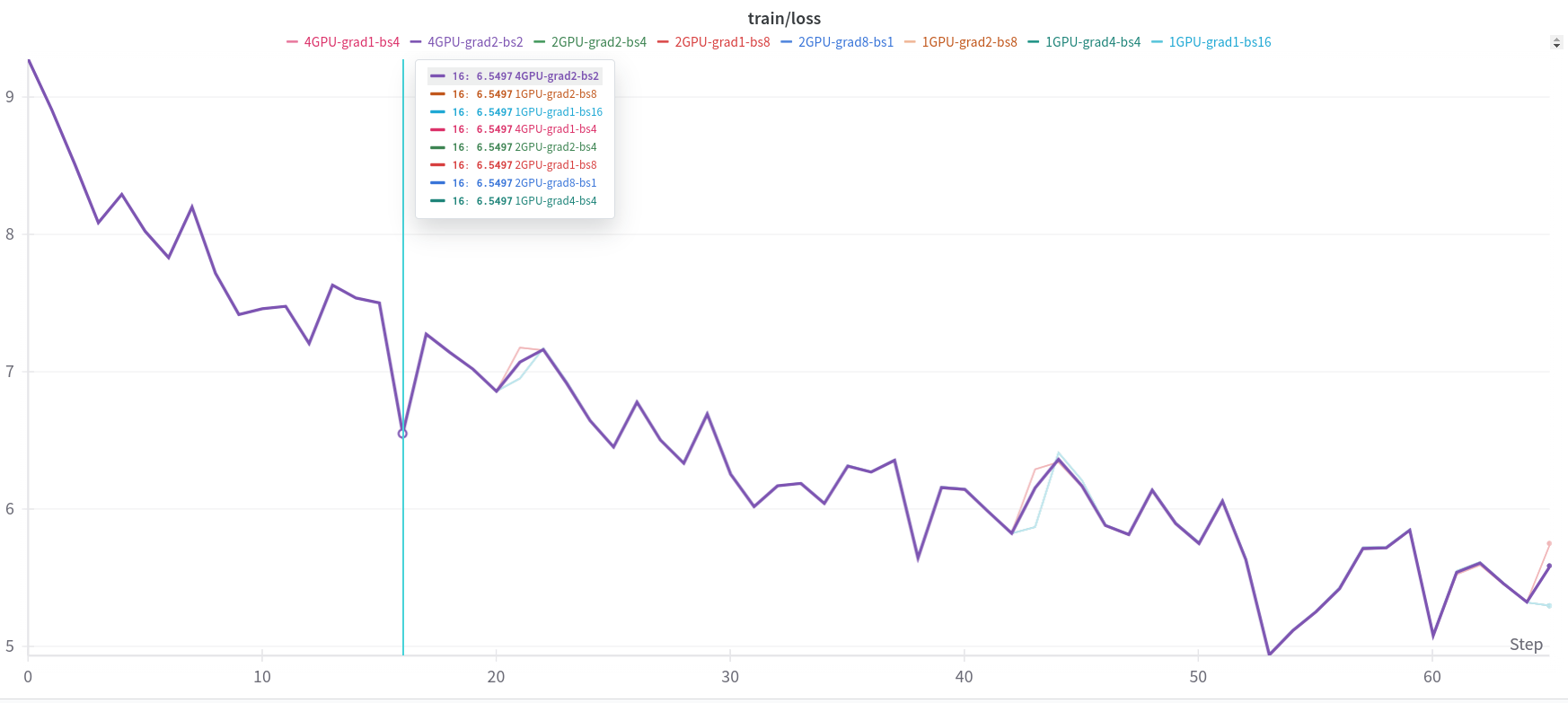
请注意,在训练步数达到 20 之前,训练损失完全相同。在此训练步数之后出现的小偏差发生在第一个 epoch 的末尾,因为按照默认设置,当总批大小不能整除数据集时,数据加载器会复制数据集开头的样本。
Update on GitHub